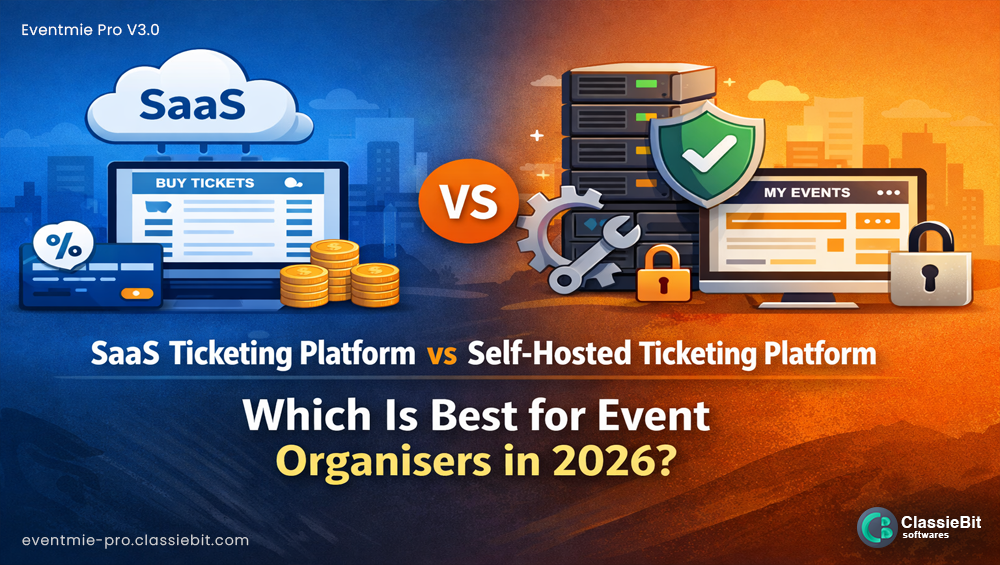
SaaS Ticketing Platform vs Self-Hosted Ticketing Platform: Which Is Best for Event Organisers in 2026?
Compare SaaS ticketing platforms vs self-hosted ticketing platforms for event organisers in 2026. Learn which model offers better control, scalability, white-label branding, and long-term value.
If you are an event organiser in 2026, ticketing is no longer just about selling passes online. It is about ownership, scalability, margins, data control, and long-term business value. For years, SaaS ticketing platforms have been the default choice. They are easy to start with and require little technical setup. But as the events industry matures, many organisers are asking a serious question; Should I keep renting a SaaS ticketing platform, or should I own my own self-hosted ticketing platform? This guide breaks it down honestly. No hype. No fluff. Just a clear comparison so you can decide what actually makes sense for your event business in 2026.
Why This Decision Matters More in 2026
The events industry has changed. Event organisers today are not just running one-off events. They are building recurring conferences, festivals, expos, workshops, and ticketing brands. Here is what has changed:
- Ticketing fees are eating margins
- Data ownership has become critical
- Customisation expectations are higher
- Compliance and security matter more
- Organisers want independence from third-party platforms
Ticketing is no longer a tool. It is infrastructure. That is why the debate between SaaS ticketing platforms vs self-hosted ticketing platforms is more relevant than ever.
What Is a SaaS Ticketing Platform?
A SaaS ticketing platform is a cloud-based service where you pay to use someone else’s software. You sign up, create your event, sell tickets, and the platform handles everything on their servers. Common examples include; Event marketplaces, Cloud ticketing tools with monthly plans, Platforms that charge per ticket sold, etc. Why organisers choose SaaS ticketing platforms; Quick setup, No hosting or server management, Minimal technical knowledge required, etc. For beginners or small one-time events, SaaS ticketing platforms can feel convenient. But convenience comes with trade-offs.
The Real Limitations of SaaS Ticketing Platforms
As your events grow, SaaS platforms start showing cracks.
- High and unpredictable fees: Most SaaS ticketing platforms charge; Per-ticket fees, Payment gateway fees, Platform commissions, etc. As ticket volume grows, so do your costs. You are essentially paying more for your own success.
- No real ownership: You do not own; The platform, The customer data, The system logic, etc. You are renting access. If the platform changes policies, pricing, or features, you must adapt.
- Limited customisation: SaaS platforms work well for generic use cases. They struggle when you need; Custom workflows, Unique pricing logic, Advanced integrations, White-labeled branding, etc.
- Vendor lock-in: Once your entire ticketing operation runs on a SaaS platform, moving away becomes painful. Your data, customers, and processes are tied to someone else’s system.
What Is a Self-Hosted Ticketing Platform?
A self-hosted ticketing platform is software you own and run on your own server or cloud infrastructure. Instead of renting software, you license it once and control everything.
Key characteristics:
- Installed on your own server
- Full access to source code or core logic
- No per-ticket commission
- Complete data ownership
This model is often confused with “open source only,” but that is not always the case. A professional self-hosted ticketing platform can be:
- Open source at its core
- Commercially supported
- Enterprise-ready
- Secure and certified
Self-Hosted vs SaaS Ticketing Platform: A Clear Comparison
A. Ownership
- SaaS: Platform owns the system
- Self-hosted: You own the platform
B. Costs
- SaaS: Ongoing fees forever
- Self-hosted: One-time or fixed licensing cost
C. Scalability
- SaaS: Limited by pricing tiers and policies
- Self-hosted: Scales based on your infrastructure
D. Branding
- SaaS: Platform branding visible
- Self-hosted: Fully white-labeled ticketing platform
E. Data control
- SaaS: Platform controls user data
- Self-hosted: You control and own all data
For organisers thinking long-term, the difference is significant.
Why White-Labeled Ticketing Platforms Are Winning in 2026
A white-labeled ticketing platform allows you to run ticketing under your own brand. No third-party logos, No external redirects, No brand dilution, etc. This matters because; Your brand builds trust, Your audience stays with you, You create repeat customers, etc. In 2026, organisers want to look like platforms, not users of platforms. Self-hosted ticketing makes that possible.
Is a Self-Hosted Ticketing Platform Only for Technical Teams?
This is one of the biggest myths. Earlier, self-hosted software required heavy technical expertise. That is no longer true.
Modern self-hosted ticketing platforms are:
- Pre-built
- Well-documented
- Professionally supported
- Designed for non-technical organisers
You do not need to be a developer. You need the right platform.
Introducing Eventmie Pro: A Self-Hosted Ticketing Platform Built for Scale
If you are considering a self-hosted ticketing platform in 2026, Eventmie Pro is built exactly for that purpose. Eventmie Pro is not an experiment. It is a trusted & certified ticketing platform with real-world usage.
Why Eventmie Pro stands out?
- 7+ years of proven development
- Designed specifically as a ticketing platform for events
- Built to handle thousands to millions of users
- Fully white-labeled
- Self-hosted and scalable
It is not just software. It is infrastructure for event businesses.
Trusted & Certified Ticketing Platform Matters
Security and compliance are no longer optional.
A. Eventmie Pro is designed with:
- AICPA-aligned security practices
- GDPR compliance readiness
- Secure data handling
B. This matters especially for:
- International events
- Enterprise organisers
- Payment and personal data compliance
A trusted & certified ticketing platform builds confidence for both organisers and attendees.
Ticketing System Open Source Benefits Without the Risk
Many organisers search for a ticketing system open source because they want flexibility.
A. Eventmie Pro offers:
- Transparent architecture
- Customisable workflows
- Developer-friendly structure
B. But unlike random open-source projects, it also provides:
- Professional support
- Regular updates
- Business-ready stability
You get control without chaos.
How Eventmie Pro Solves Real Organiser Problems
- Zero per-ticket commission: You keep 100 percent of your ticket revenue.
- Full data ownership: Your customers belong to you, not a third-party SaaS platform.
- Scale without restrictions: From small workshops to large-scale events, the system grows with you.
- Multi-vendor and admin control: Run; Single organiser events, Multi-organiser marketplaces, Enterprise event networks, etc. All from one system.
Who Should Choose SaaS Ticketing Platforms in 2026?
SaaS ticketing platforms still make sense if:
- You run one-time or hobby events
- You do not care about branding
- You are testing an idea temporarily
They are not wrong. They are just limited.
Who Should Choose a Self-Hosted Ticketing Platform Like Eventmie Pro?
Eventmie Pro is ideal if:
- You run recurring events
- You want predictable costs
- You care about brand ownership
- You want to build a long-term ticketing business
- You want independence from platform policies
If ticketing is central to your business, owning the platform changes everything.
The Long-Term Business View
SaaS platforms are expenses. Self-hosted platforms are assets. When you invest in a self-hosted ticketing platform; Your costs stabilize, Your margins improve, Your brand strengthens, Your business becomes resilient, etc. That is why more organisers in 2026 are shifting away from rented platforms.
Conclusion:
Choosing between a SaaS ticketing platform and a self-hosted ticketing platform is no longer just a technical decision. In 2026, it is a business decision that directly affects your margins, your brand, and your long-term growth as an event organiser. SaaS ticketing platforms still serve a purpose for small or short-term events. They are easy to start with, but they come with ongoing fees, limited control, and dependency on third-party policies. As your events scale, those limitations become harder to ignore. A self-hosted ticketing platform, on the other hand, gives you ownership. You control your data, your branding, and your ticketing operations. When combined with a white-labeled ticketing platform approach, you are no longer just selling tickets. You are building your own event ecosystem under your brand. The future of event ticketing belongs to organisers who think long-term. If ticketing is central to your business, owning your platform is no longer optional. It is the smarter move for 2026 and beyond. In the end, the best ticketing platform is the one that works for you, not the one that locks you in.
 G2
G2 Capterra
 GetApp
 GoodFirms